
ENUGU 2027: WHY CHIEF UCHE GEOFFREY NNAJI’S VISION FOR ECONOMIC RELIEF, INDUSTRIALISATION AND PEOPLE-CENTRED GOVERNANCE DESERVES ATTENTION — A COST-BENEFIT ANALYSIS
By Obasi Obinna Obaino Gbaaduu
Media Frontier | Enugu
INTRODUCTION: ENUGU’S 2027 GOVERNORSHIP DECISION
As Enugu State looks towards the 2027 governorship election, the choices before Ndi Enugu extend beyond political affiliations and campaign promises. They concern the state’s economic direction, the welfare of its citizens, the management of public assets, industrial development, and the principles of equitable political representation.
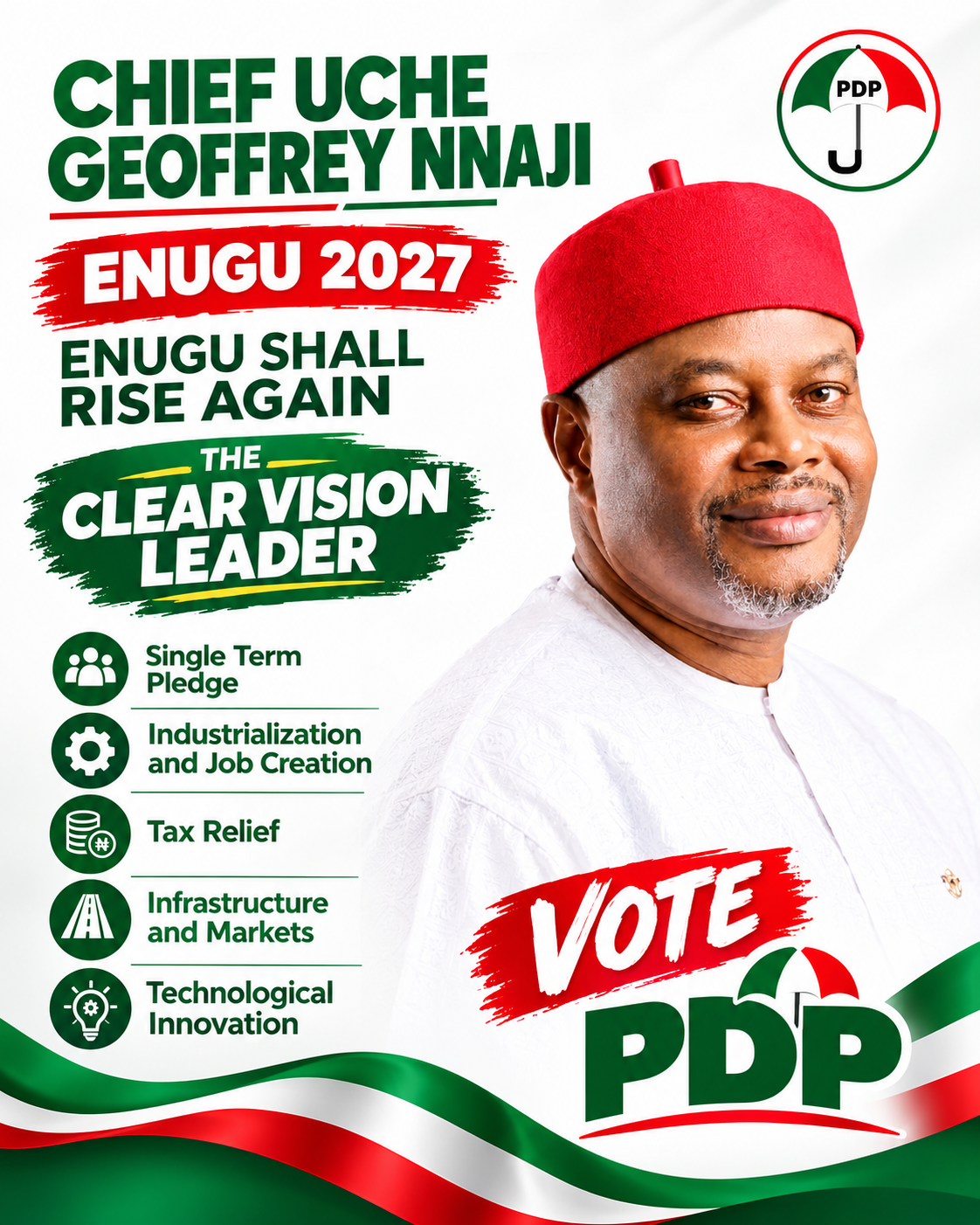
Against this backdrop, Chief Uche Geoffrey Nnaji of the Peoples Democratic Party (PDP) is presenting an alternative vision for the state. His campaign emphasises reviewing the tax system, stimulating industrial production, protecting public assets, and promoting policies that place citizens’ welfare at the centre of governance.
This analysis examines seven major issues through a cost-benefit framework, comparing concerns raised about the current administration with the policy commitments attributed to Nnaji. The objective is to encourage Ndi Enugu to assess the candidates based on their records, proposals, feasibility, and potential impact on the state’s future.
1. TAXATION AND ECONOMIC RELIEF: REDUCING THE BURDEN ON CITIZENS
One of the central issues in Enugu’s political debate is the relationship between internally generated revenue and the financial pressure experienced by residents and business owners.
Critics of the current administration have raised concerns about taxation and levies affecting traders, landlords, hospitality businesses, transport operators, and small-scale entrepreneurs. They argue that revenue generation must not come at the expense of livelihoods, business survival, and household welfare.
Nnaji’s campaign has emphasised economic relief, a review of taxes considered excessive or counterproductive, and greater support for small and medium-sized enterprises. The underlying argument is that government should create an environment in which businesses can grow, employ people, and contribute sustainably to public revenue.
For traders at Ogbete Main Market, landlords in Independence Layout, students in Nsukka, and entrepreneurs across the state, the critical question is whether government policies can strike a better balance between revenue generation and economic opportunity.
The cost-benefit question:
Can Enugu build a stronger revenue base by supporting productive economic activity rather than placing disproportionate pressure on citizens and small businesses?
2. INDUSTRIALISATION VERSUS A CONSUMPTION-DRIVEN ECONOMY
A second major issue is how Enugu can transition from an economy heavily dependent on commerce, services, and revenue collection to one that generates more wealth through production and industrial activity.
Nnaji’s campaign identifies industrialisation as a central pillar of its proposed development agenda. The vision involves exploring the state’s mineral resources, agricultural potential, technological capacity, and human capital to attract investment and establish productive industries.
Locations such as Emene, the 9th Mile area, and Nsukka could feature in a broader industrial development strategy, subject to infrastructure, feasibility studies, environmental safeguards, and investor participation.
As an industrialist and Chairman of Rose Group, Nnaji brings private-sector experience that his supporters believe could inform his approach to investment, manufacturing, and job creation.
The comparison with the industrial development associated with Dr Michael Okpara’s administration in the former Eastern Region also offers a historical reference point for discussions about production-led growth.
The cost-benefit question:
Which economic model offers Enugu the greater long-term benefit: one focused primarily on revenue collection and infrastructure development, or one that also prioritises manufacturing, agricultural processing, and sustainable employment?
3. PROTECTING PUBLIC ASSETS AND ENUGU’S HERITAGE
The management of public assets is another issue requiring careful public scrutiny.
Concerns have been raised by critics over proposals involving the sale, lease, or concession of strategic state-owned assets. Such arrangements can attract investment and improve efficiency when properly structured, but they can also create long-term public costs if valuation, transparency, contractual safeguards, and expected returns are inadequate.
Nnaji has been presented by his supporters as favouring a more transparent approach to the management of public assets, with emphasis on competitive processes, clear financial benefits, and accountability to the people.
Any government considering a major asset transaction should disclose its rationale, demonstrate the value expected by the state, and establish appropriate safeguards for public interest.
For Ndi Enugu, the issue is not simply whether an asset should be sold, leased, or concessioned. It is whether the arrangement represents a fair and sustainable benefit to the people.
The cost-benefit question:
How can Enugu attract investment and improve public infrastructure without compromising transparency, accountability, or the interests of future generations?
4. ZONING, POLITICAL EQUITY, AND THE ONE-TERM COMMITMENT
Political zoning and equitable representation remain important considerations in Enugu State’s political landscape.
Supporters of Nnaji have highlighted an alleged one-term commitment associated with an event at Akpugo on August 15, 2026. According to the campaign narrative, the commitment was intended to address concerns about political balance among the state’s three senatorial districts.
The argument is that a clearly stated four-year commitment could help strengthen confidence in zoning arrangements and create opportunities for broader political inclusion in subsequent electoral cycles.
However, the implications of any such commitment should be assessed against the actual terms of the agreement, the relevant political stakeholders’ positions, and the constitutional framework governing elections and tenure.
Political equity is important, but it must also be accompanied by respect for democratic choice, constitutional provisions, and accountability in public office.
The cost-benefit question:
Can a credible and transparent political understanding promote fairness among Enugu’s senatorial districts while preserving democratic principles and public accountability?
5. CANDIDATURE, INEC LISTING, AND LEGAL CERTAINTY
Questions surrounding candidates’ eligibility and official nomination status can significantly influence an election campaign.
The article’s original argument points to Nnaji’s reported appearance on INEC’s provisional candidate portal as evidence relevant to the debate about his candidature. Such a listing is an important development to examine, but it should not automatically be treated as a final determination of every possible legal challenge.
The legal position must be established through the applicable electoral laws, official INEC records, and any relevant judicial decisions. Claims about disqualification should likewise be evaluated on the basis of verifiable evidence rather than speculation or social media commentary.
For voters, the essential consideration is whether a candidate satisfies the legal requirements for election and whether the nomination process complies with the law.
The cost-benefit question:
How can voters make an informed decision based on verified candidature information, applicable constitutional provisions, and authoritative legal determinations?
6. TEACHERS’ WELFARE AND PEOPLE-CENTRED GOVERNANCE
Education is fundamental to the long-term development of Enugu State, and teachers play a central role in determining the quality of learning available to future generations.
Nnaji has been credited by his campaign with a commitment to collaborate with the state’s 17 local government areas to improve primary school teachers’ salaries and working conditions.
If implemented effectively, such a policy would require clear funding arrangements, cooperation among the relevant tiers of government, transparent implementation plans, and measurable standards for evaluating progress.
Improving teachers’ welfare could contribute to staff motivation, retention, and a stronger learning environment. At the same time, sustainable education reform should include adequate learning materials, school infrastructure, professional development, and accountability for educational outcomes.
**The cost-benefit question:** Which policies can deliver lasting improvements in teachers’ welfare and educational standards while remaining financially sustainable?
7. THE FINAL COST-BENEFIT MATRIX: WHAT SHOULD GUIDE THE VOTER?
Ultimately, the 2027 governorship election presents Ndi Enugu with an opportunity to evaluate competing visions for the state’s future.
The case advanced by Nnaji’s supporters rests on several priorities: reviewing the tax burden, promoting industrialisation, safeguarding public assets, encouraging political equity, ensuring legal certainty, and improving teachers’ welfare.
The current administration’s policies should be assessed against the same standards, including measurable achievements, financial sustainability, transparency, employment creation, and improvements in residents’ quality of life.
For voters, the comparison should go beyond campaign slogans. It should examine the credibility of each candidate’s proposals, the resources required to implement them, and the safeguards that would ensure accountability.
The ultimate question is whether Enugu can build an economy that creates opportunities, protects public interests, supports small businesses, improves education, and delivers inclusive development.
CONCLUSION: THE PEOPLE’S MANDATE MUST BE EARNED
Enugu’s future depends on leadership choices informed by evidence, realistic policy commitments, and a clear understanding of the people’s needs.
Chief Uche Geoffrey Nnaji and the PDP are presenting their proposed agenda as an alternative centred on economic relief, industrial growth, public accountability, and people-oriented governance. Supporters believe these priorities offer a compelling basis for considering his candidacy in 2027.
However, the strength of any political alternative ultimately depends on the clarity of its plans, the feasibility of its promises, and its willingness to be held accountable for results.
As Ndi Enugu prepare to make their choice, the most important consideration is which candidate can best translate promises into practical, measurable improvements in the lives of the people.
The 2027 decision should be about more than political personalities. It should be about the kind of Enugu State Ndi Enugu want to build.
Don't miss a single update
Related Stories
Nwakabie’s Campaign Agenda Sparks Debate: Are His Promises Reshaping Governance in Enugu State?
OBE WARD REAFFIRMS SOLIDARITY WITH NWAKABIE, RENEWS COMMITMENT TO PDP AHEAD OF 2027

BREAKING: ODAA OPUU MOURNS AS HE LOSES HIS BELOVED MOTHER