
Leadership Beyond Allegations:Why Performance must Remain Part of the Conversation
Rt.Hon Bar Jonathan Chukwuma Former Deputy Speaker Of Enugu State House of Assembly.
As children, many of us watched traditional wrestling contests and wondered what made one wrestler triumph over another. With time, we learned that the most respected champions were not those who relied on distractions or controversies. They were men who stepped into the arena with confidence in their abilities, preparation, discipline, and strength of character.
That lesson remains relevant today, especially in politics.
In every democratic society, political competition should be driven by ideas, competence, integrity, vision, and a demonstrated capacity to serve the people. Unfortunately, public discourse is often consumed by accusations, counter-accusations, and controversies that overshadow substantive conversations about governance and development.
This reality becomes particularly evident whenever allegations,especially those already before the courts, become the dominant lens through which a political figure is assessed. In a constitutional democracy, disputes and allegations are meant to be resolved through due process and the rule of law. Until such matters are conclusively determined, citizens have a responsibility to distinguish between allegations and established facts.
At the same time, it is both legitimate and necessary for the public to examine a leader’s record in office. Political leadership should be evaluated not only through controversies but also through measurable achievements, administrative competence, policy contributions, and service to the public.
For this reason, many observers maintain that public officials should ultimately be judged on the totality of their record. What initiatives did they champion? What challenges did they confront? What reforms did they introduce? What tangible results did they deliver? How effectively did they manage the responsibilities entrusted to them?
These are questions that deserve thoughtful consideration whenever citizens assess those who seek higher office.
The future of any state or nation is too important to be reduced to political slogans, personal attacks, or unresolved controversies alone. Democracy is strongest when voters critically evaluate leadership qualities, performance, vision, and character while allowing legal institutions to perform their constitutional responsibilities without prejudice or interference.
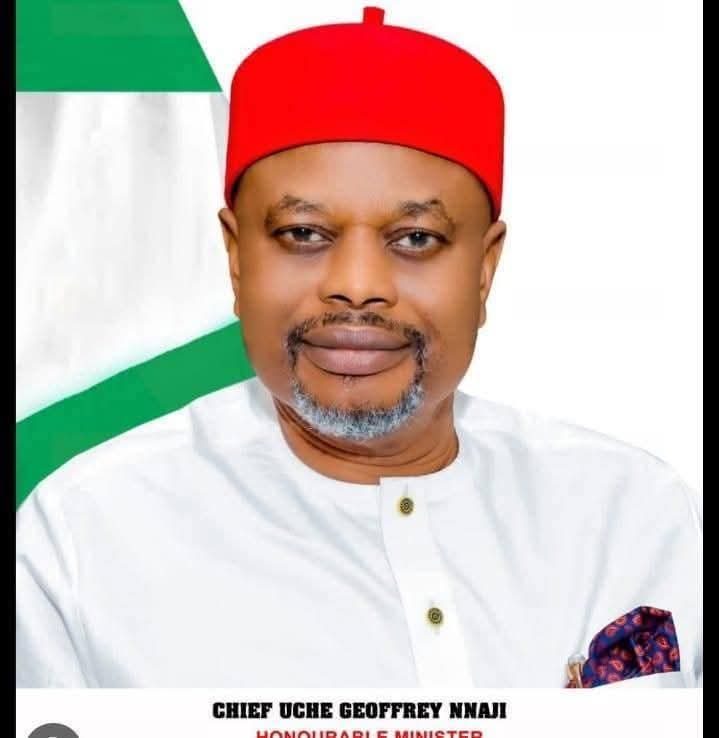
Against this backdrop, it is important to consider the record of Chief Uche Geoffrey Nnaji during his tenure as Nigeria’s Minister of Innovation, Science and Technology.
Chief Uche Geoffrey Nnaji: Achievements That Should Not Be Overlooked
Chief Uche Geoffrey Nnaji’s tenure was marked by several initiatives aimed at strengthening Nigeria’s technological capacity, innovation ecosystem, agricultural productivity, and industrial development. Whatever views may exist regarding allegations surrounding his academic credentials, a fair assessment of his public service should also consider the outcomes achieved under his leadership.
Among the notable accomplishments recorded during his stewardship was the advancement of Nigeria’s satellite development programme, including plans for additional optical and synthetic aperture radar satellites designed to enhance national security, environmental monitoring, disaster management, and scientific research. He also championed efforts toward establishing a domestic drone manufacturing facility while supporting the development of unmanned technologies and renewable energy solutions.
In the agricultural sector, the ministry facilitated the commercial release of TELA maize, an insect-resistant and drought-tolerant variety developed to improve food security and increase farmers’ productivity. The ministry further supported the release of improved cowpea and cotton varieties, expanded cassava value-chain initiatives, and promoted biotechnology-driven agricultural innovations aimed at strengthening Nigeria’s agricultural competitiveness.
Chief Nnaji also pursued strategic partnerships and memoranda of understanding with local and international institutions in areas such as artificial intelligence, climate innovation, renewable energy, space technology, and technology commercialization. His administration encouraged innovation grants, promoted clean-tech entrepreneurship, supported startup development, and advanced efforts toward the realization of Abuja Tech City as a major hub for technology-driven investment and economic growth.
Furthermore, his ministry intensified efforts to commercialize research outputs through innovation expos, technology exhibitions, startup competitions, and collaborations among researchers, inventors, investors, and industry stakeholders. These initiatives were designed to transform scientific discoveries into commercially viable products capable of generating employment, attracting investment, and creating economic value.
These achievements may be debated, critiqued, or measured against expectations, as is normal in any democracy. However, they remain part of the public record and should not be ignored when evaluating his performance in office.
Beyond Certificates: The Value of Capability
While allegations concerning academic credentials have generated public attention, it is important to recognize that allegations and performance are separate issues. Public accountability remains essential, and every allegation deserves appropriate legal scrutiny. However, fairness also requires acknowledging demonstrable contributions and measurable outcomes.
History offers countless examples of individuals whose impact on society was determined not merely by certificates or academic titles but by competence, innovation, leadership, creativity, and the ability to solve real-world problems. Certificates may open doors, but capability is what produces results.
The world’s most productive economies, including the United States, China, South Korea, Singapore, and Germany, have achieved success by rewarding innovation, productivity, technical expertise, entrepreneurship, and performance. Their progress has been driven not by credentials alone but by the ability of individuals and institutions to create value, solve problems, and deliver measurable outcomes.
Therefore, while allegations should be subjected to due process and lawful determination, they should not automatically eclipse a comprehensive assessment of an individual’s record of service.
As political conversations continue, citizens should insist on a higher standard of debate, one that prioritizes facts over rumours, performance over propaganda, evidence over emotion, and informed judgment over partisan sentiment.
Ultimately, productive countries do not rely solely on certificates; they rely on capabilities. What drives national progress is the capacity of individuals to innovate, lead, build institutions, create opportunities, solve problems, and deliver results that improve the lives of citizens.
That is why leadership should always be judged on the full weight of the evidence; achievements, vision, competence, character, and accountability, not on allegations alone. Go East, West, South and North, NWAKAIBEYA for a REASON!
Corgito ergo sum;
Don't miss a single update
Related Stories

Nwakabie’s Campaign Agenda Sparks Debate: Are His Promises Reshaping Governance in Enugu State?

The Golden Voice of the Tube: Remembering Ruth Benamaisia-Opia, the Incomparable NTA Icon Whose Elegance Defined Nigerian Television History

OBE WARD REAFFIRMS SOLIDARITY WITH NWAKABIE, RENEWS COMMITMENT TO PDP AHEAD OF 2027