
ENUGU’S DAILY TOLL SCAM: Taxing Survival: How Daily Levies on the Poor Became Enugu’s Most Controversial Revenue Policy
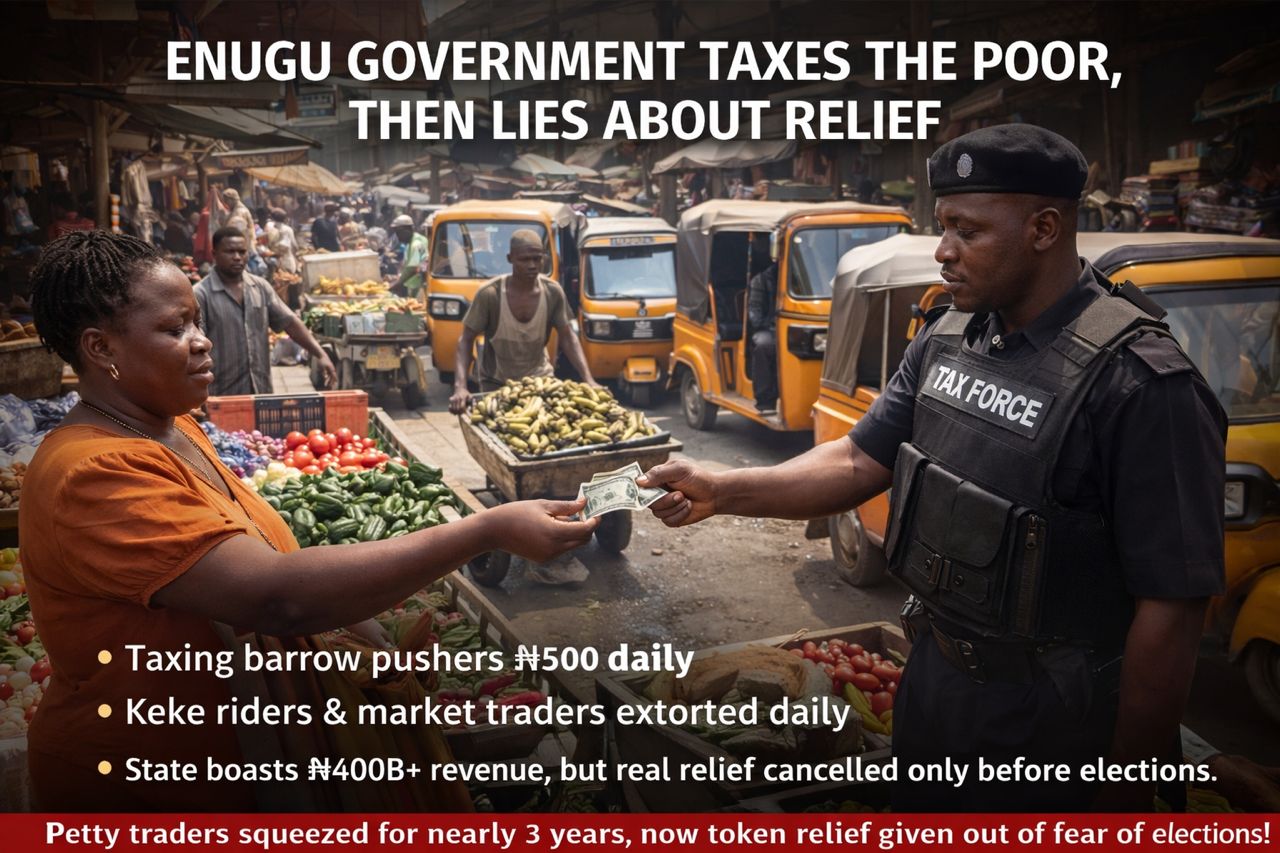
For nearly three years, the poorest people in Enugu State have been taxed for breathing.
Not corporations.
Not billionaires.
Not the politically connected.
Petty traders. Wheelbarrow pushers. Keke drivers. Market women. Street hawkers.
The very people struggling daily just to survive.
THE POLICY THEY NOW WANT YOU TO FORGET
Let’s call it what it was:
A ruthless, anti-poor revenue machine.
Every single day:
• Wheelbarrow pushers paid about ₦500 daily
• Keke riders and bus drivers were taxed relentlessly
• Petty traders—selling vegetables, pepper, fruits—were not spared
No shelter.
No infrastructure.
No support.
Just daily extraction.
Rain or shine.
Profit or loss.
Food or no food.
Pay—or face harassment.
THE NUMBERS EXPOSE THE TRUTH
Now here is where it gets even more disturbing.
Enugu State proudly announced it generated over ₦400 billion in 2025
—and is projecting over ₦800 billion going forward.
Pause and think.
If you are generating hundreds of billions…
👉 Why are you squeezing ₦500 daily from wheelbarrow pushers?
👉 Why are pepper sellers and fruit hawkers part of your revenue model?
This is not governance.
This is systematic extraction from the bottom of society.
And now, after building a revenue system heavily fueled by these harsh collections…
They announce a “minor adjustment” and expect applause.
THREE YEARS OF SILENCE… NOW SUDDEN COMPASSION?
For almost three years, this policy stood.
No urgency.
No empathy.
No relief.
Then suddenly—months before elections—a dramatic announcement:
“We have suspended daily tolls for petty traders without shops.”
And we are expected to clap?
Clap for what exactly?
For stopping what should never have started?
THE CRUEL LOGIC STILL REMAINS
Even in this so-called “relief,” the injustice continues.
👉 Traders without shops are exempted
👉 Traders with shops will STILL PAY
So the burden is not removed—
it is merely adjusted and disguised.
And again the question:
Where are the benefits?
• Are markets modernized?
• Is there structured support for traders?
• Are transport operators given relief or incentives?
Or is it simply:
Collect. Increase. Project more. Repeat.
⸻
THIS IS NOT KINDNESS—THIS IS CALCULATION
Let’s be honest.
If this policy is wrong today,
it was wrong three years ago.
If it is unjust today,
it was unjust from day one.
So why now?
Because elections are close.
And the optics suddenly matter.
WHAT HAPPENS IN A SECOND TERM?
This is the real danger.
A government that could enforce this level of economic pressure in its first term—
what happens when it no longer needs votes?
Because the logic is clear:
👉 First term: endure public anger
👉 Second term: govern without restraint
If this is what was done when accountability still mattered…
What happens when it no longer does?
THE PEOPLE ARE WATCHING
The market woman remembers.
The keke rider remembers.
The wheelbarrow pusher remembers.
These are not just voters.
These are people who were taxed at the edge of survival.
FINAL WORD
This is not reform.
This is not empathy.
This is not leadership.
This is damage control wrapped in propaganda.
Because no government that truly cares about its people:
👉 Builds massive revenue from the poorest
👉 Defends it for years
👉 Then suddenly reverses a fraction when elections approach
Enugu people must not be deceived.
You don’t applaud a system for reducing injustice.
You question why the injustice existed at all.
Don't miss a single update
Related Stories
Nwakabie’s Campaign Agenda Sparks Debate: Are His Promises Reshaping Governance in Enugu State?
The Golden Voice of the Tube: Remembering Ruth Benamaisia-Opia, the Incomparable NTA Icon Whose Elegance Defined Nigerian Television History
OBE WARD REAFFIRMS SOLIDARITY WITH NWAKABIE, RENEWS COMMITMENT TO PDP AHEAD OF 2027